Online panels have a credibility problem
We commissioned a national survey from one of the largest online panels in the world and we ran it twice. In the second round, 29.6% of the records came back with chatbot text in the written answers. The bots had worked out what we check for and they went around it. The panel couldn't tell us why. They couldn't tell us how to stop it either. We could not use the study.

We commissioned a national survey from one of the largest online panels in the world and we ran it twice. In the second round, 29.6% of the records came back with chatbot text in the written answers. The bots had worked out what we check for and they went around it. The panel couldn't tell us why. They couldn't tell us how to stop it either. We could not use the study.
November 2026. Based on 872 completed interviews across two rounds of fieldwork in India, September 2026. The panel provider is one of the largest in the world. We have not named them.
In September we commissioned a benchmark survey from one of the world's largest online panel providers. It bombed. We binned the first round, the provider looked into it and changed something, so we ran the study again. By the end of October we had nothing we were willing to show a client. Two rounds of fieldwork, a lost field window, no benchmark.
What took us completely by surprise was how good the bots were. We went in expecting the cheat we had always dealt with, somebody racing the questionnaire for the incentive. We got the opposite. Whatever was on the other end of this had worked out what a research company looks for in a file, and it handed us a file that looked right. Now, we can't tell you whether a program was answering our survey or a person was doing it with a chatbot open in a second tab. We never did settle that, and I'll show you why not. But we know for a fact that nobody sat and typed these answers.
So let me take you through it in the order we found it. Every check we trusted failed, and each time one failed we had to go looking somewhere else.
The whole survey came back in one day
Our first flag was the speed, and it was the only thing that flagged on its own. We asked for about 700 interviews over seven days. That works out at about 98 a day, and we meant to sit and watch the timings as the file filled up over the week. All 683 interviews landed on 14 September. The first one came in at 10:57 in the morning. The last one at 22:39 at night.
Seven days of fieldwork, delivered in twelve hours
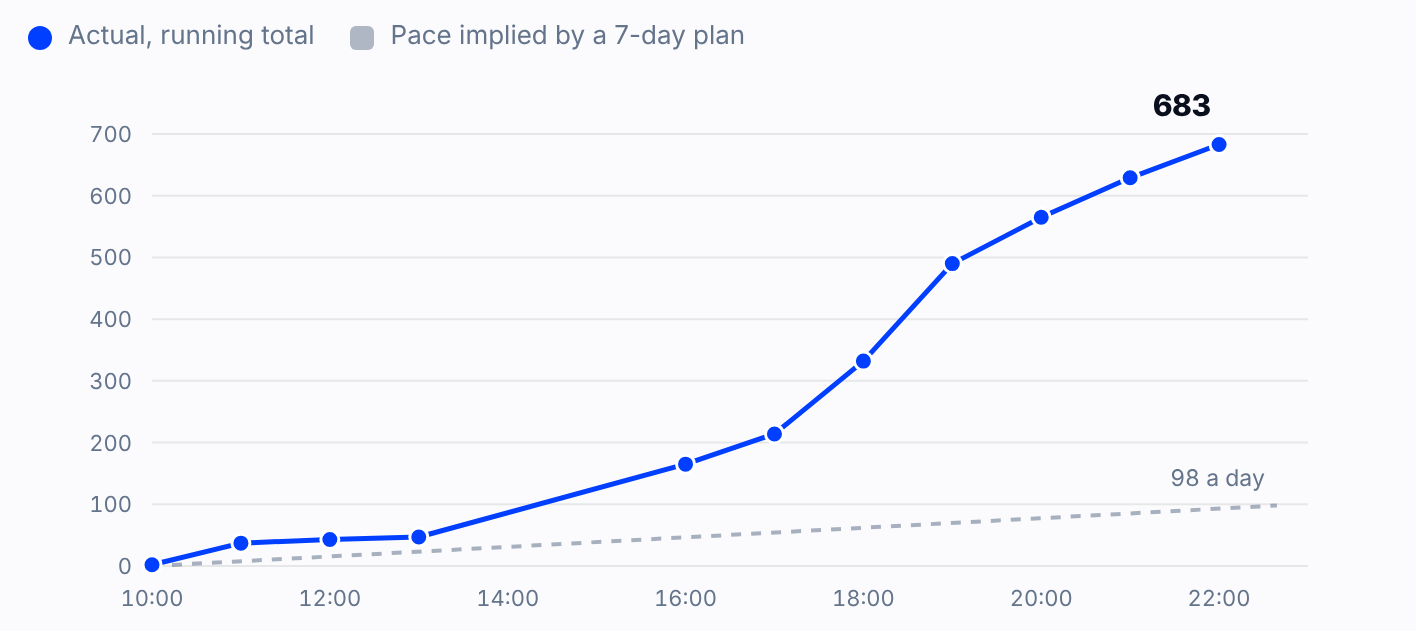
A whole week of fieldwork in twelve hours made us suspicious. And our first thought was the obvious one. Somebody rushed it.
So let me tell you where our 12-minute floor came from, because it matters for what happened next. Before launch we had one of our own people sit and take the survey as a respondent. It came out at about 12 minutes. That became the minimum. Our assumption was simple. If some "human" was answering for the sake of answering, they would do it much faster than a person doing it properly, and 12 minutes would catch them.
Then we looked at the timings. Every record cleared the floor. The shortest interview took 12 minutes, the median 19, the longest 59. And the survey's own quality check marked all 683 of them valid.
Our speed checks caught the wrong people
So the clock did not give it away. We sat there waiting for short interviews and they were not short. Hang on. Everything is taking longer, not less. That was the moment we stopped trusting our own checks, and it is the reason the rest of this piece exists.
What took us completely by surprise was the level of sophistication. They knew the business. Research companies look for fast surveys and bin them, and research companies like a long, full written answer. So they took their time. We had assumed a fake respondent would race. They seem to have worked out that racing is what gets you caught, and they adjusted. They took a leisurely 16 minutes.
That is a reading, not a measurement, and here is the measurement under it. When we sorted the second round into the records we flagged and the records we cleared, the flagged group was the slower one. Median 16 minutes. The group we cleared ran 12.
The people we flagged took longer than the people we cleared
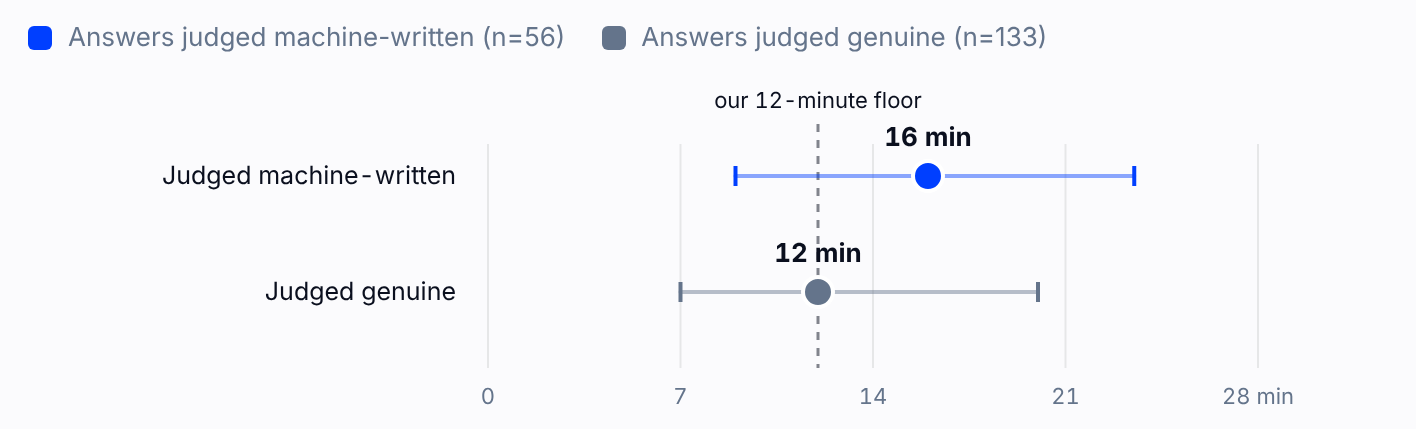
66% of the flagged group ran 12 minutes or longer. In the group we cleared it was 51%. Now, the flagged group also answered more questions, a mean of 3.6 against 2.6 out of seven, so I am not telling you the chatbot ate all of those extra minutes. The direction is what matters. Our floor sat at 12 minutes and the suspect records strolled past it. Two thirds of them walked.
I'll tell you what we had in our heads when we built those checks. A speeder who races the questionnaire in four minutes. A straightliner who picks the same column all the way down a grid. Somebody skipping questions to get to the incentive. Every one of those checks watches the clock. None of them reads the answer. We never thought to build a trap for something patient, because it never crossed our minds that a cheat would be patient.
And the panel was looking in exactly the same place we were. Think about what a panel is. Millions of people who signed up ahead of time, with their age, income and city on file. A survey comes along, and at the door the panel asks each account a few questions. Is this ID real? Yes. Is this the device we have on record? Yes. Have you been with us a while, and did you answer at a sensible speed? Yes and yes. Have we seen you in here twice? No. In you go. Every one of those questions asks the same thing. Is this a real person, and are they who they say they are? Not one of them asks who typed the answer. So the records we ended up throwing out walked straight through all of it, from accounts with real histories on ordinary devices.
Somebody has already put a number on this. A NORC review from April 2026 cites Westwood, who built a chatbot respondent and ran it at the standard data quality checks. It passed 99.8% of them. The review itself adds that "even vendor solutions, such as Qualtrics fraud flags, fail against sophisticated attacks." So the bots are smart. Ours worked out that a quarter of an hour makes you invisible. Then it sat there for a quarter of an hour and walked out with a record our quality check marked valid.
Eight written questions are why we saw it at all
The clock was gone, the panel's own checks were no help, and we still had a file we did not believe. The only thing left to look at was what people had written. And we only had enough writing to look at by luck. This questionnaire carried far more written answers than a normal panel survey does. That is the only reason you are reading this.
The study spanned eight product categories: banks, health, life and motor insurance, investment platforms, two-wheelers, four-wheelers and retail. Each one had closed questions, where you pick from a list or score out of ten, and open ones, where you get an empty box and write what you want. Say a brand scores 7 against a category average of 6. The client knows there is ground to make up. But the score cannot tell them whether the trouble is the queue in the branch or the app crashing. They need that reason in the customer's own words. So the study carried eight written questions, one per category, each asking the same thing. Why would you recommend this brand?
Now, that "why" is a question I am guessing a brand tracker or a product test does not ask. They probably ask it once or twice. Not eight times. Written answers cost money to code and people do not like typing, so most buyers keep them to a minimum. We asked eight times, once per category. And because the categories have nothing to do with each other, bank and then car and then insurer, we could hold one person's eight answers against each other.
One written answer cannot be audited
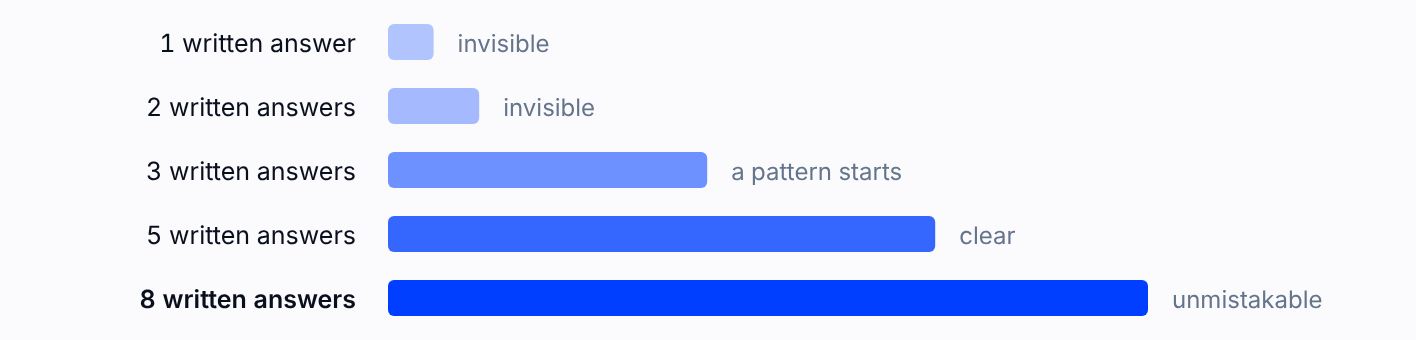
Here is the one thing the bots got wrong. They answered the open ends. That part they could do, and they did it in better English than most of our real respondents. What they could not do was make eight of them different from each other.
And one written answer cannot be audited. Read on its own, almost any sentence about a bank sounds plausible. Read eight from the same person, across eight unrelated purchases, and the template has nowhere to hide. That is how they turned up. In the first round, 18 people opened four or more of their answers with the same sentence frame, and one person used it in all eight.
They sent the same sentence with a different brand
Some of the first round took no technique at all. One person was asked why they'd recommend LIC, the government-owned life insurer. They typed this into the box:
Option 1 (Trust & Security): I would recommend LIC primarily for its
unmatched sovereign guarantee and government backing; which ensures complete
financial security for policyholders. (153 characters)Option 2 (Reliability
& Claims): LIC stands out for its high claim settlement ratio; long-standing
market trust; and the absolute safety assurance provided by the Government
of India. (150 characters)Key Points to IncludeSovereign Guarantee: Mention
the financial backing of the Government of India. [...]
You can see the whole thing happening. Give me about 150 characters on why I'd recommend LIC. The chatbot comes back with two versions, counts the characters of each one, and adds a note about the points to cover. And the person pastes the lot, notes included. Whoever sent that in was not reading what they sent.
An answer like that is the start of the trail, not the finding. The finding came from going back to that person's other seven answers, and then to everybody else's. And this part was not clever work. We put the written answers in a spreadsheet and sorted them. It took seconds. 55 of the 683, 8.1%, gave an answer of five words or more that matched someone else's word for word.
What the first round actually contained
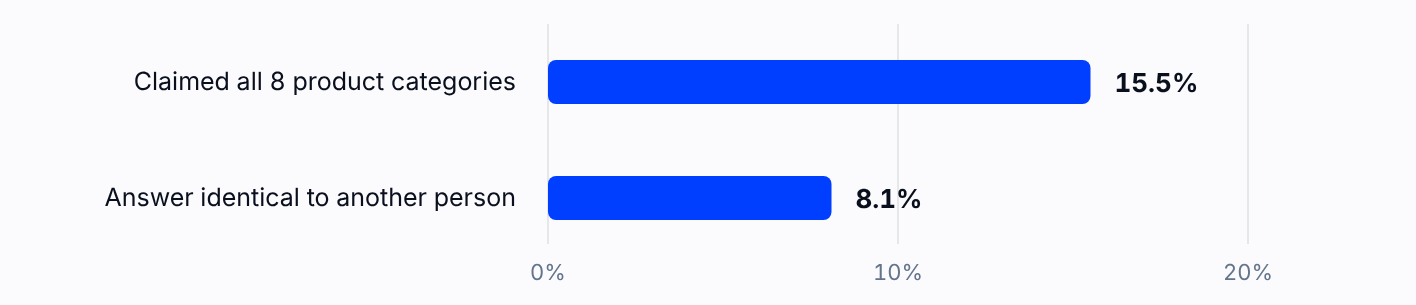
Then look at what people in that same file claimed. 106 of them, 15.5%, said they used brands in all eight categories. So on paper every one of them held three kinds of insurance, invested through a broker, and owned both a two-wheeler and a car. Now, every category you claim gets you one more written question to answer. A person who wants the incentive and wants out claims as few as they can get away with. These accounts claimed the lot and took the extra work on. That tells you something about who was doing the work, and it also gave them eight chances to match somebody else's text where the rest of the file had about four. Per answer, this group matched 9.5% of the time. The rest of the file matched 4.8%.
Respondents IN107179 and IN107813 are the clearest pair in the file. Their panel IDs are 634 apart. Both live in Delhi NCR. One started the survey at 20:00 and the other at 20:25 the same evening. Both took about 20 minutes, well over our 12-minute floor. Both claimed all eight categories. And their first two answers, on their bank and their insurer, are identical, character for character. Both accounts sent in exactly this:
I would recommend State Bank of India because of its wide branch and ATM
network; reliable banking services; and strong reputation.

I would recommend HDFC ERGO because of its reliable insurance services; wide
range of coverage options; and good claim support.
The other six answers from both accounts run off the same template with the brand swapped in. Here are IN107179 and IN107813 on Honda, in that order. One word is different.
I would recommend Honda because of its reliable performance; good fuel
efficiency; and low maintenance costs.

I would recommend Honda because of its reliable performance; excellent fuel
efficiency; and low maintenance costs.
Two people in the same city opened the same survey 25 minutes apart and typed the same sentences, down to the semicolons. I don't believe they're strangers.
These accounts were all set up together
The duplicates told us there were templates in the file. They did not tell us where the templates were coming from. So we went and looked at the panel IDs, and that is where it got interesting.
If a group of people from a panel answer your survey, you would expect their IDs to be scattered at random right across the panel, because a panel has millions of accounts built up over years and the people free on a given afternoon have nothing in common with each other. Ours were not scattered. They came in small groups. Little clusters of IDs, answering together.
Why would that be? Here is how the numbering works, and then I'll give you our answer. Every account on a panel gets a number when it is created. That number is its panel ID. The panel hands the numbers out in order, so two accounts opened on the same afternoon get numbers close together, the way house numbers run down a street. An account opened a year later sits far down the road. In our first-round file, the lowest and highest IDs were 10,154 apart.
Now take two strangers who happen to write the same sentence. Each of them signed up on their own, whenever they got round to it. So their two account numbers could land anywhere in that span of 10,154. If the accounts that share text sit side by side in the numbering, they were opened at about the same time, because that is what the numbering records. What we can't tell you from the numbers alone is whether they also came in through the same route.
That pair of respondents is the sharpest case, and the rest of the file does the same thing. The 55 people who shared an answer fall into 16 groups, and inside each group the account numbers sit close together. So we put a figure on it. For each group we measured how much of the ID range it covers, lowest number to highest, and the typical real group covers 13.5% of it. Then we asked what those groups would look like if the numbers meant nothing at all. We kept the 16 groups the same size and dropped their members into the file at random. Done that way, the typical group covers 44.6% of the range. More than three times the real figure. We repeated the shuffle 20,000 times. The shuffled groups came out as tight as the real ones about once in 10,000 tries, p = 0.0001.
People who shared an answer have panel IDs close together
How to read it: each line is one group of people who sent in the same answer. The line runs from the lowest panel ID in the group to the highest, so a short line means the accounts were opened close together. Top, in blue: the 16 real groups. Bottom, in gray: the same 16 groups moved to random spots in the file, for comparison.
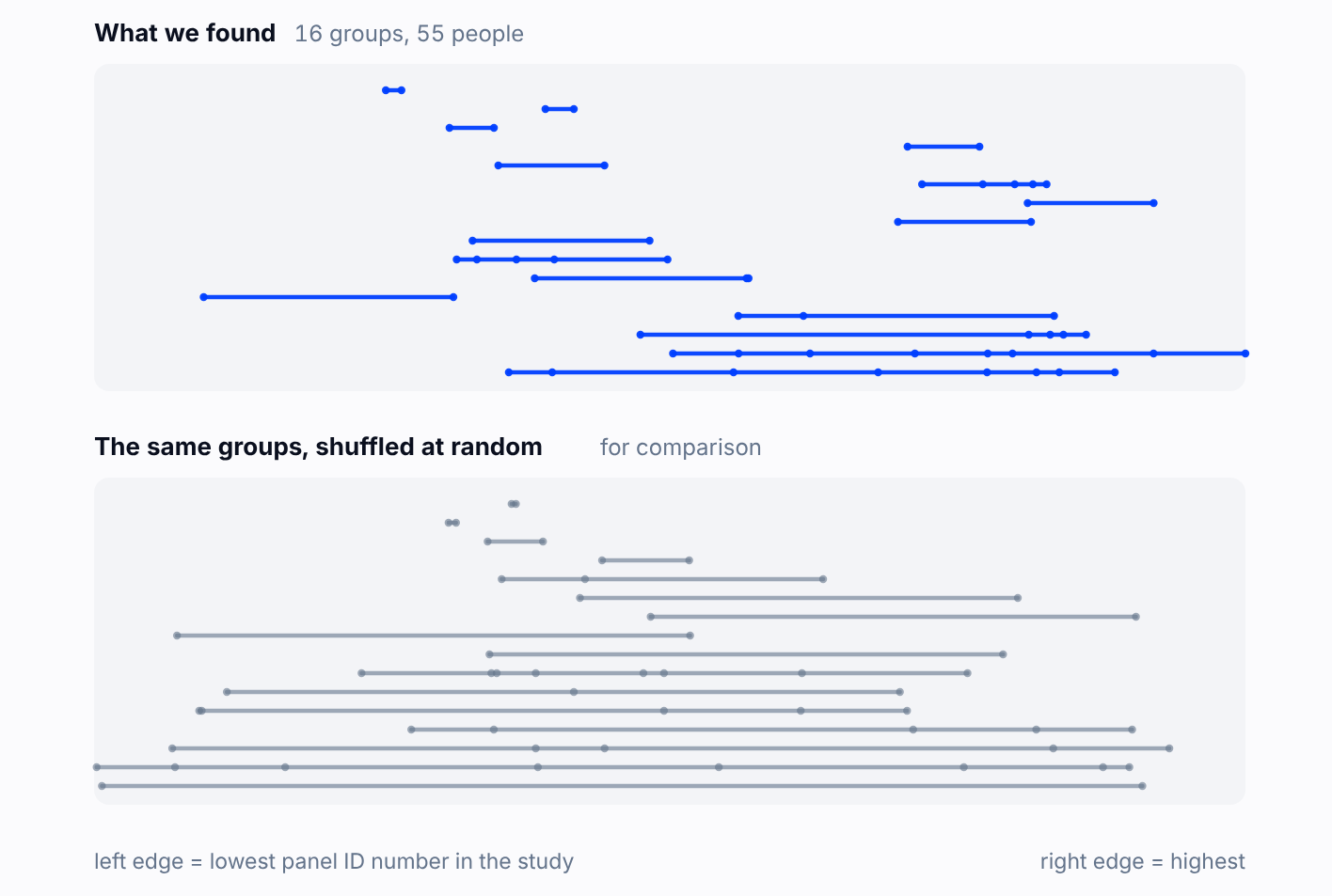
The people who claimed all eight categories turn up here too. 23 of the 55 who shared an answer had also claimed all eight. If the two things had nothing to do with each other, you'd expect about 9. We allowed for the extra answer boxes that group fills, and a split that lopsided would still come up only about four times in a thousand by chance, p = 0.004.
So why would the IDs bunch? This is a guess, but it is the only explanation we have that makes sense of all of it. There are bot farms that have signed up to the panel and been handed a block of accounts. And that is how machines work. Somebody tells a program, go and get me a few hundred IDs on this panel. The program goes and gets them, one after another, in one sitting. So the numbers come back sitting next to each other. Then a survey lands in those accounts and they all get on and answer it together. The few hundred is my illustration and not our finding, because what we actually have is 55 people in 16 groups. But it is the shape of the thing.
A farm explains the one day too. 683 interviews don't arrive in a day because 683 separate people were unusually keen. They arrive in a day because something switched on a block of accounts and worked through the questionnaire with all of them at once. And whoever runs it was being careful. The answers came in slowly enough to pass a speed check and spread over twelve hours rather than twelve minutes. That is somebody thinking about what we would look at. Again, it's a guess, but that is what we think caused the ID bunching.
What the file can't tell us is who the farm belongs to. One person may hold all 55 accounts, and that is fraud. Or one recruitment channel let them all in, and that is a sourcing problem. The panel would shut accounts for the first and shut a recruitment channel for the second. The file doesn't say which they need to do.
They changed the link, and the chatbot text stayed
We binned the first round and sent them the evidence. To their credit, they agreed there was a problem. Their client services lead wrote to us on 16 September, two days after the file landed.
We identified a potential issue with one of our recruitment methods that may
have resulted in AI responses not being detected during our quality checks.
The issue has been escalated to the relevant team for urgent review and
corrective action.
The provider changed the encrypted redirect formula. That is the link that passes a survey back to the panel when it is done, and it is the thing you change if accounts are sending the same survey in more than once. They also put up a small batch of 100 first for us to inspect. We agreed, dropped the first round and went again.
The second round ran from 23 to 28 September with seven categories, one fewer than the first. It gave us 189 records instead of 683, spread across six days instead of piled into one. The duplicates went from 55 people to zero. Not one person sent in another person's text, and the spreadsheet sort that took seconds the first time found nothing at all.
So the fix did something. It also took away the one test we had, because you cannot sort a spreadsheet for duplicates that are not there. And one test we could not run at all: we did not re-run the ID clustering on the second round, so I can't tell you whether blocks of accounts stopped signing on together.
Nobody had read the first round record by record, since we binned it on day two. So the only thing we could point at both rounds and ask the same question of was a program we had written to spot the marks that pasting leaves behind. The program misses most of what a reader catches, so its overall rate doesn't mean much on its own. But if the fix had reached the writing, the share of records carrying paste marks should have come down between the rounds.
What the fix moved, and what it did not
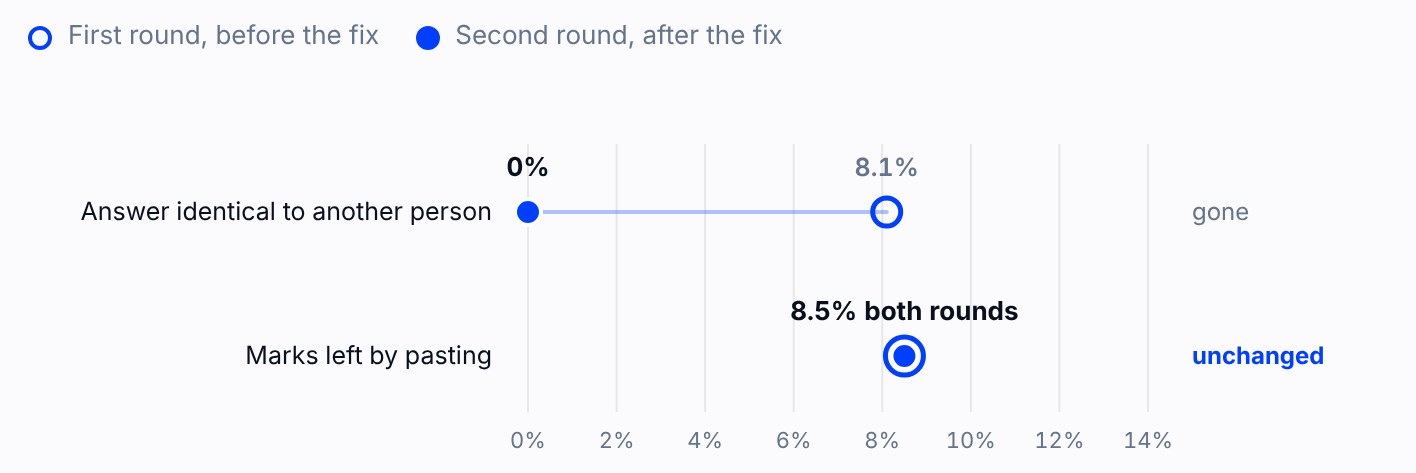
The share of records carrying paste marks did not come down. It was about 8.5% in the first round and it was about 8.5% in the second. So we had agreed to the fix. We had run a whole second round on the strength of it, and we got fewer responses, no duplicates, no two people sending in the same sentence. And then we opened the answer boxes and people were still handing us text a chatbot had written.
No test caught this, we caught it by reading
So by this point the clock had failed, the panel's checks had failed, the duplicates had gone and the program was finding almost nothing. A person reading the file is what caught the second round.
One of our analysts went through each of the 189 records and read all of that person's answers at once, bank next to insurer next to car. These four came from two people and four products:
I would recommend State Bank of India because it is a trusted bank with
reliable services; convenient digital banking; and a wide network of
branches and ATMs.

I would recommend Bajaj Allianz because of its reliable insurance services;
convenient claim process; good customer support; and range of plans to suit
different needs.

I would recommend Hyundai because of its comfortable cars; modern features;
good design; reliable performance; and convenient service network.

I would recommend Angel One because of its easy-to-use platform; convenient
investment options; and helpful features for managing investments.
Anyone might say State Bank of India is a trusted bank with a wide branch network. But put the same person's bank answer next to their car answer and only the brand name and the nouns after "because" have changed. Here is what the answers we cleared look like, out of the same files:
i recommend state bank of india because it is trusted

Ji mujhe ye barand kafi pasand hai very good bank so best of my life is liye
nhi ho gaya hai

GOOD CUSTOMERS SERVICE LOW INTEREST FOR CASH TRANSACTION

it's a good bank. the employees are also good; and all works are done fast
These people typed in lower case. They left caps lock on. They slid from Hindi into English and back. They stopped a sentence where they stopped thinking. That is what a real answer looks like, and it is nothing like a tidy list of three benefits with semicolons in it. Read that way, 56 of the 189 records, 29.6%, carried answers we judged to be chatbot text. Some of them took no judgment at all. This one came from a person asked why they'd recommend their stockbroker:
ore AdvantagesTradeTiger Platform: Advanced desktop terminal for deep
technical analysis.Research Backing: In-depth fundamental and technical
reports.Zero Mutual Fund Fees: No commission or transaction fees for online
mutual funds. [...] ⚠️ Key ConsiderationsFull-Service Pricing: Brokerage
rates are higher compared to basic discount brokers. [...] If you want to
compare further; tell me:
The paste was clipped, so it starts mid-word. "ore Advantages" was "Core Advantages." A warning symbol is doing the job of a heading. And it ends with the chatbot asking to keep going.
Now, we can't tell you which of those 56 records were a bot filling in a form and which were a person reading each question with a chatbot open in a second tab, pasting the reply back, then moving on to the next brand. A panel keeps no record that tells those two apart. But we know for a fact that nobody sat and typed them.
Reading worked. The trouble is that reading does not scale. The analyst took days to get through 189 records, and a real study is 2,000, so we tried to teach the program to do her job. It looks for the marks pasting leaves behind. A warning symbol. A heading jammed into a sentence. A character count. A first clause that repeats the question back at you. Run over the same 189 records, it picked out 16. 15 of the 16 were already among the 56 she had flagged. On the sixteenth, she saw a person writing and the program saw paste marks, and when we went back to it we never settled which was right, so it sits in the file as clean.
What a machine can catch, and what it cannot
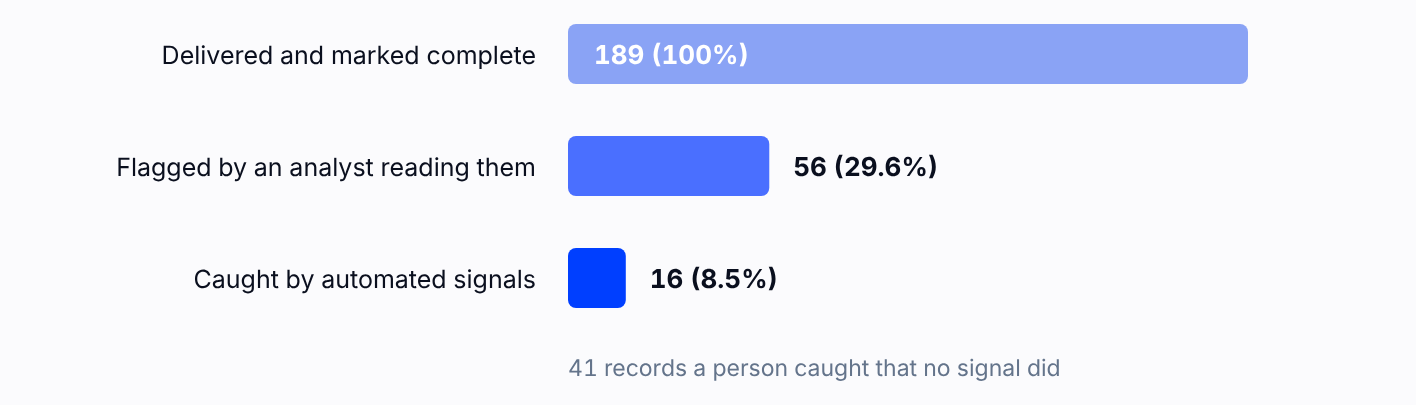
The 41 records in the gap are the ones that worry me. No stray symbol. No broken spacing. Fluent, on topic, the right length. There is nothing in them for a machine to find. The only thing wrong with them is that one person wrote eight of them off one frame. So when I give you 29.6%, that is what two rounds of reading turned up. Put a third reader on the same 189 records and I think they would find more.
We asked them to fix it, and then we gave up
At nearly a third of the file there is nothing to work around. You can't weight it away. You can't bank the closed questions and drop the written ones. And you can't tell a client that the reasons behind their scores came from an unknown mix of their customers and a chatbot. We had run out of tests of our own, so we went back to the panel with the records. We sent the 56 flagged ones over and asked the same question again. On 8 October a project manager in their client services team replied.
Based on our investigation, we found that all respondents included in the
data file you shared are legitimate respondents with established tenure and
a reasonable history of survey participation during 2026. Therefore, we did
not identify any indications of bot activity in the data.

Regarding the poor-quality open-ended responses, please feel free to reject
those responses if they do not meet your quality parameters. Unfortunately,
we do not have control over the content respondents choose to provide in
open-ended questions.

For the rejections related to suspected AI-generated responses, while the
data indicates potential AI activity, our investigation confirms that the
respondents themselves are legitimate and have valid survey participation
histories. At this stage, we are unable to determine why some responses may
appear to be AI-generated.
Read that next to the September letter. Same study, same accounts, three weeks apart, opposite findings. In September the problem was a recruitment method. In October there were no indications of bot activity. Both answers came out of checking whether the account holders were real people. They may well be real people. Neither answer says a thing about who or what wrote the text, which is the only question we were asking.
Then the same letter told us something nobody had told us when we commissioned the study.
This is an industry-wide challenge, and our Tech team is actively working on
a permanent solution. In the meantime, we are currently assuming an overall
reconciliation rate of approximately 10-15%, which also accounts for such
responses.
The panel assumes 10 to 15% of records get thrown out. Nobody mentioned that rate when we commissioned the study. Nobody mentioned it in their first reply three weeks earlier either.
So two rounds in, we stopped trying to filter the text. If they can beat anything we read for, take the typing away. We asked the panel to require audio on the written questions. People speak their answer, we type it up, the client can listen back, and nothing gets typed or pasted. Their account manager came back on 16 October with four reasons it couldn't be done. More people quit a survey when it asks them to record audio. People on laptops and desktops hit recording problems. Voice files carry personal data, so privacy law comes in, and so does the industry's own research code. And their legal team would have to rule on whether a data sharing agreement was needed.
All four are real. From their side of the contract all four are reasonable. The account manager offered a survey where each person could pick text or audio, and anybody pasting from a chatbot is going to pick text. So there was no way left to buy what we needed. We just gave up. We didn't buy a third round. The study stopped there on 30 October.
The bots are in, and we buy differently now
Our figure comes from one study, with one provider, in India, counted by our own people reading each record. So I can't tell you what share of online panel research has this problem. Other people have measured around it. A Stanford working paper asked panel members straight out, and 34% said they had used a chatbot to help answer open-ended questions. The same paper found chatbot answers run more alike and more positive than human ones. So a benchmark built on them pushes every brand toward the same pleasant middle and closes the real gaps between them. That is the damage. Not a messy file, a flattering one. NORC's April 2026 review of the research puts fraud across the market research industry at 15 to 30%. The provider told us they assume 10 to 15%.
Our next benchmark won't run on a panel. We're going to run it face to face and film each interview. That is slower and it costs more for 2,000 interviews, and we're buying it anyway, because of the cost asymmetry. To fake a video of a real person in their own home, a fraudster still needs equipment, time and skill. To paste an answer, they need about 30 seconds.
Faked video is getting better fast, though. A few years from now a faked interview may cost a fraudster very little. When that happens we'll need something else again, and I don't yet know what it'll be. Most surveys will stay on panels, ours among them. So for those we've changed how we buy.
- No fieldwork file gets signed off until our analysts have read every written answer in it.
- Every study carries at least five written questions, spread across topics with nothing in common, so we can read one person's answers against each other.
- The 12-minute floor stays, and it still comes from a human taking the survey before launch. But we now read the slow tail as well, because the group we flagged in this study ran a median of 16 minutes.
- Before we sign with any panel we ask two questions. What rate of machine-written answers do you assume in your pricing, and can your answer boxes block paste and record typing? A paste block stops a person copying out of a chatbot tab. It does nothing about an agent filling in the form.
Nobody has worked out who pays for a record that passes every check and turns out to be a chatbot's. A real person who pastes a chatbot's answer might be a fraud. Or they might be a new kind of respondent who needs a new kind of question. The industry hasn't settled which. And we haven't seen a provider publish a check that looks for a person taking their time.
After two rounds we had 133 records, all from the second round, holding 345 written answers we believe a person wrote. The one in caps about low interest on cash transactions is in there. So is the one that slides from Hindi into English and back again. You can't build a benchmark on 133 people. Out of the 872 interviews across the two rounds, those are the ones we kept.
Which means the bots are inside the online panels, and they are not the crude cheat our checks were built for. They worked out what we look for and they went around it. That's our reading, and it's what we are working on now. So it is very hard to take panel data and use it without being skeptical of the quality of it. The only test we have found that works is one of our own people reading every word.
---
Notes
- Zhang, S., Xu, J., and Alvero, A.J. Generative AI Meets Open-Ended Survey Responses. Stanford Graduate School of Business.
- NORC at the University of Chicago. Fraudulent respondents and bots in nonprobability surveys. April 2026. The Westwood and Hitches findings are cited there.
- Westwood, S. The potential existential threat of large language models to online survey research. PNAS.
- Provider correspondence, 16 September and 8 October 2026, quoted verbatim. Provider not named.