Predictive Experience Intelligence [PXI]
Numr PXI finds where your highest-value journeys stall, predicts why each customer stopped, and sends the message that moves them forward. Revenue impact measured to the dollar.
Built for financial services. The pilot runs on one weekly customer file, no integration needed.
See how it works
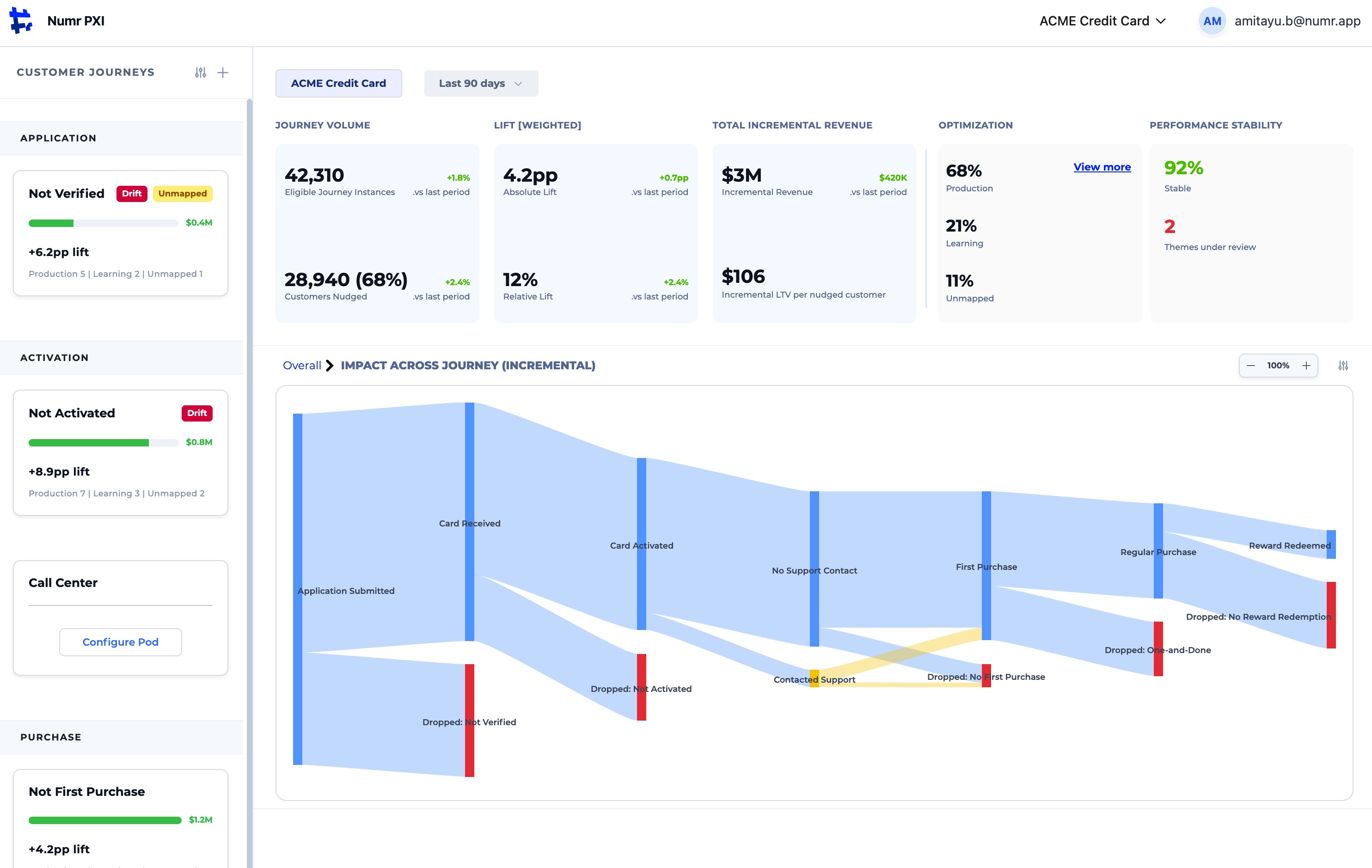
$417,960
incremental revenue recovered
774 more customers moved forward

Trusted by teams at
The Problem
These aren't lost customers. They chose you. They started the journey. They are stuck right now.
You already paid to acquire every one of them. Every day they sit stuck, that money earns nothing. It's a friction tax on growth you already bought, and most banks only see it in the quarterly funnel review. 90 days too late to act.
Five stages. One continuous loop.
A loop that learns. Every intervention makes PXI better at predicting why customers stall and what moves them.
01 · Signal
PXI reads the behavioral, transactional, and operational signals across the systems you already run, and detects the moment a high-intent journey stalls instead of moving forward.
02 · Pod
When a journey stalls, PXI groups every customer caught at the same drop-off moment into one operational cohort. A bank with 92,000 unfunded accounts isn't 92,000 problems. It's a handful of Pods.
03 · Reason
Customers in the same Pod don't stall for the same reason. PXI predicts the most likely reason for each one.
04 · Action
PXI tests messages to find what actually moves a stuck customer forward, sent through your existing channels.
05 · ROI
PXI watches each nudged customer actually reach the next step. Every one that moves is stuck revenue released, proven not projected.
Five stages. One continuous loop.
A loop that learns. Every intervention makes PXI better at predicting why customers stall and what moves them.
One loop. Every intervention teaches PXI, so it gets sharper at predicting the stall and choosing the message.
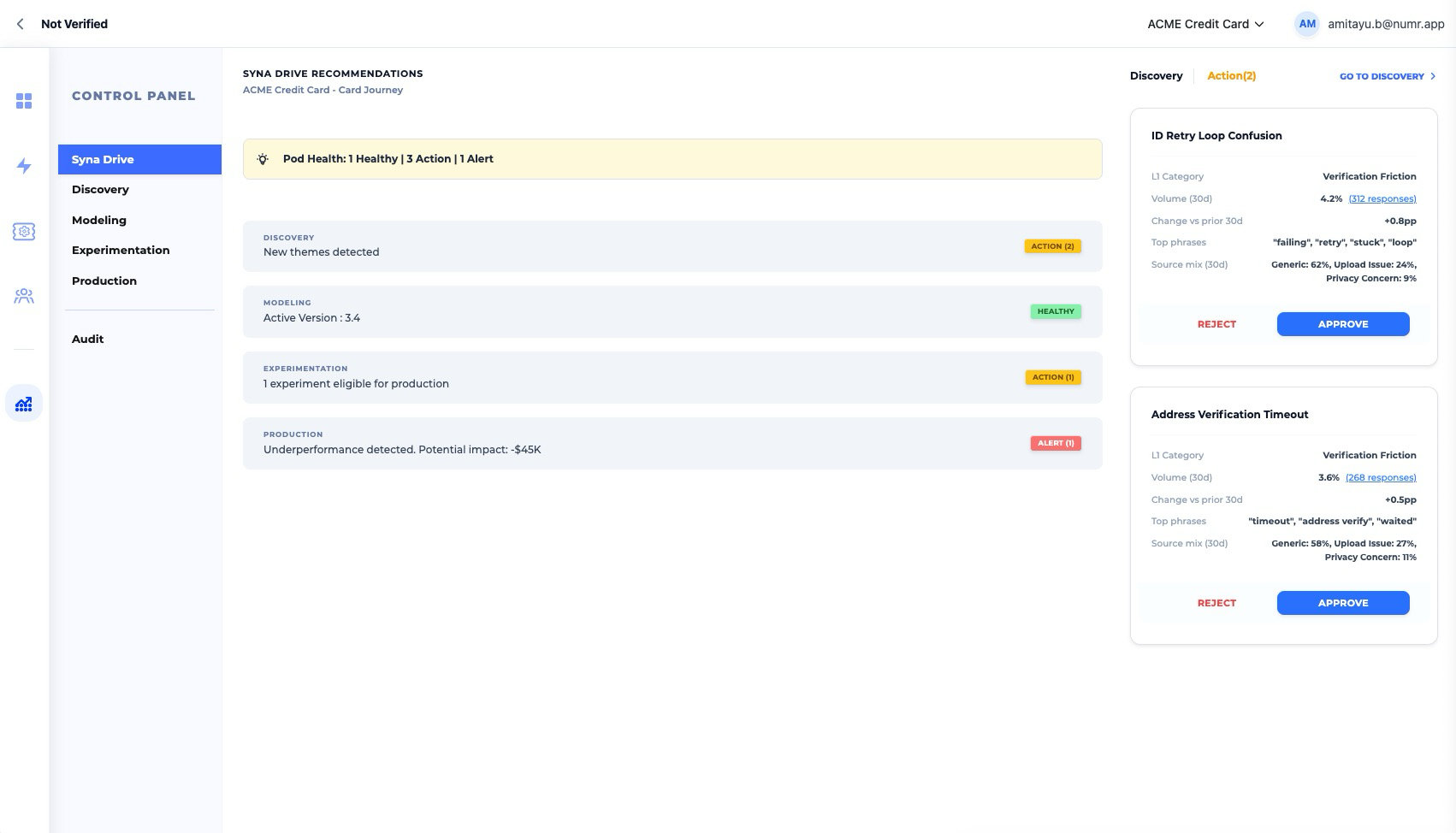
The stall it found. The group it built. The reason it predicted. The message it wrote. The results it watched. All of it was Syna Drive.
To do this with people, you would need a data scientist, a marketer, a growth lead, and an engineer to integrate it and run it in production. Then keep all four in step, restarting the cycle for every stalled group, every week. Teams like that lose to their own calendar. Syna Drive runs the full cycle overnight, and nothing it produces reaches a customer until you approve it.
That is the division of labor. The agent carries the work. You keep the judgment. Approve, and it ships. Hold it, and it waits.
Delivery Model
PXI runs as a managed system. You don't need a data-science team to use it, because you already have ours.
Onsite when you want us
Our integration team works onsite with your IT group to connect PXI to your core and digital banking stack. Your systems, your pace, your security review. We come to you, and we leave when it's wired in.
Offsite, always on
Our data-science team builds and calibrates the models, runs the randomized tests that prove the recovery is real, and keeps the whole loop tuned. You see the results. They do the math.
Have a modeling team of your own? Run PXI in-house. Don't have one? You'll never notice. Either way, you're covered.
Every financial services firm has one. You already paid to acquire the customers stuck in it. A pilot shows you where it is, what it costs, and what it takes to collect.
30 minutes to know if there's a pilot worth running. One stall point, one weekly customer file, one measured revenue number in 90 days.