How to Improve Digital Product Adoption in Banks
Practical steps for moving customers from opened to genuinely active.

TL;DR
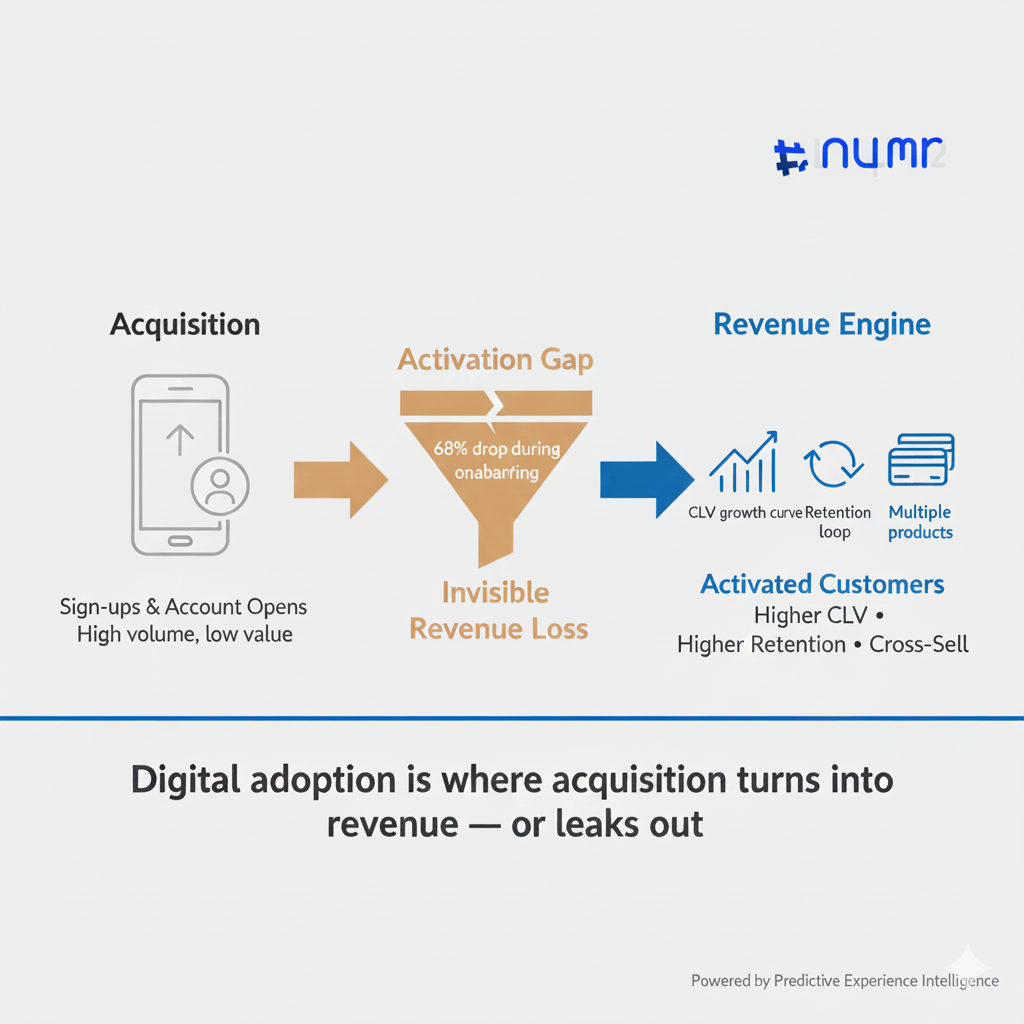
You are facing banking’s greatest paradox: 89% of consumers rely on mobile apps, yet an estimated 68% abandon digital onboarding.
Improving digital product adoption requires moving beyond slick UX and implementing a predictive strategy that uses behavioral signals to intervene, recover lost conversions, and protect the $2.09 trillion digital banking market.
The Strategic Imperative: Why Digital Adoption is Your Next Revenue Engine
As a retail banking CXO, you've won the battle of acquisition, but you are still losing the war on activation. Every customer you acquire but fail to activate is not a missed opportunity. It is a wasted investment that erodes customer lifetime value.
The numbers clearly illustrate the stakes:
- Financial Upside: Banks with effective digital adoption strategies report 17% higher CLV among digitally engaged customers. Moreover, a 5% increase in customer retention can boost your profits by 25% to 95%.
- The Churn Threat: The failure to drive adoption directly threatens your bottom line. Banks with strong digital experiences report retention rates 2.4x higher than those struggling with adoption.
- The Cost of Inactivity: The problem is acute: digital checking account openings dropped 3% to just 16% of total openings in 2024, despite widespread customer preference for digital channels. This abandonment crisis represents millions in lost customer acquisition costs.
The challenge isn’t data availability - it’s visibility. Most banks already have the data but fail to interpret them as signals or the system to connect them to churn or revenue risk.
“While sentiment analysis has been a useful starting point, helping to gauge customer emotions, the true value lies in the predictive capabilities of AI, anticipating customer needs, streamlining operations, and enabling proactive engagement before issues arise.”
– Craig Crisler, CEO at SupportNinja
This expert insight underlines why simply tracking events isn’t enough; you must predict customer behavior and act on it before adoption breaks happen.
We believe the future belongs to institutions that treat activation as a revenue-critical process, not a technology checklist. This guide shows you how.
1. Stop Measuring Sign-Ups; Start Tracking the Friction Signals
The first step in improving adoption is confronting the invisible revenue drain caused by silent churn - a phenomenon that hides in your "active" customer base.
Silent churn occurs when a customer looks good on paper, they signed up for a card or downloaded the app - but has effectively disengaged, meaning your bank holds:
- Credit cards issued but never used.
- New app users who download the app but never transact.
- Accounts that are open with a zero balance for months.
These disengaged customers poison your cross-sell campaigns and LTV models. Your reporting tools are likely blind to this, as they rely on lagging indicators.
This is the gap Predictive Experience Intelligence is built to close.
Numr’s behavioural cohorting identifies these accounts and pinpoints what is blocking activation, whether that is an unfunded account or an inactive card, so you can re-engage or reallocate. Behavioural silence becomes something you can act on rather than something you discover in a quarterly review.
This is where CX automation for banking becomes essential. Real-time customer insights for banks are only valuable when they trigger immediate, coordinated action, automated nudges for unfunded accounts, contextual in-app prompts for first transactions, or RM alerts for high-value customers showing early disengagement. PXI closes the loop by not just detecting silent churn signals, but by automatically orchestrating the right intervention at the right moment, across digital and human channels. Instead of relying on delayed campaigns or manual follow-ups, banks can systematically convert early friction into activation, transforming real-time insight into automated CX actions that protect revenue and accelerate adoption.
2. Revolutionize Onboarding with Predictive Intervention
The onboarding process is where the majority of customers - up to 68% - are lost. Fixing it means moving past generic welcome emails to progressive, personalised intervention.
Once friction signals are visible, these interventions can be triggered with precision - instead of generic campaigns.
Your focus must be on:
A. Implementing Progressive Onboarding
Research shows that 60% of customers would abandon an application if it was too lengthy or cumbersome. Rather than presenting every feature at once, introduce core functionality immediately and reveal advanced capabilities as the customer demonstrates readiness.
B. Deploying Signal-Triggered Guidance
The objective is to guide customers through friction points before they abandon, using contextual signals rather than scheduled campaigns. PXI detects subtle intent - like a customer repeating a feature peek or abandoning a transactional flow - and triggers immediate, contextual guidance or a Relationship Manager (RM) outreach. This approach:
- Reduces the likelihood of high-cost calls by preempting the service spike.
- Drives product usage. For example, PXI recognizes when a customer explores investment options but fails to complete a transaction, prompting the right in-app nudge to convert that exploration into usage.
3. The Cross-Sell Dividend: Linking Adoption to Wallet Share
The true measure of successful adoption is not just retention, but the expansion of your share of wallet. When a customer actively uses one digital product, mobile deposits for example, you earn the standing required to cross-sell the next one.
The data confirms the substantial cross-sell dividend: Customer advocates hold 17% more products with their primary bank compared to non-advocates. These customers allocate significantly more of their financial portfolio to your bank, including:
- +12% more on personal loans
- +18% more on investments
- +30% more on insurance products
Our PXI framework strengthens this relationship by identifying where customer relationships are weakening, analyzing the reasons, sending actionable triggers, and thereby automating reactivation, thus protecting this highly valuable CLV.
4. Master the Paradox: Unifying Digital Convenience and Human Trust
While digital is the primary access method for 55% of US consumers, your digital strategy must respect the omnichannel reality. Your customers still desire the trust signal of a human safety net: 71% of consumers say in-person access is important, and 68% say phone support is essential.
You must integrate your digital and physical touchpoints seamlessly:
- Integrate Digital and Physical: Allow customers to start a loan application digitally and seamlessly complete it with a Relationship Manager in the branch without losing data or progress.
- Proactive Trust Signals: Address security and trust concerns proactively, especially since security remains a significant barrier to adoption for your market. Biometric authentication and clear, real-time transaction alerts are non-negotiable trust builders.
5. The Metrics That Drive Boardroom Decisions
Proving the return on adoption work means reporting metrics tied to shareholder value rather than vanity scores.
Business Impact Metric | Why It Matters to the Board | How NUMR PXI Quantifies It |
|---|---|---|
CLV Enhancement | Directly measures revenue generated over the customer lifespan. | PXI strengthens CLV by identifying where customer relationships are weakening, unfunded accounts, inactive cards, or low engagement segments, and automating reactivation.
|
Conversion Recovery Rate | Measures the percentage of lost revenue we recover from abandoned flows (e.g., loan applications). | Tracks the dollar value of lost conversions recovered due to PXI-triggered interventions and reports it directly as recovered revenue . |
Cost-to-Serve Reduction | Tracks efficiency gains from successful digital migration and deflection. | PXI preempts service spikes and yields lower Average Handle Time (AHT) and fewer repeat contacts, converting service savings into measurable OPEX reductions. |
That shift takes the conversation from reporting satisfaction to reporting retained revenue, which is the version the board actually responds to.
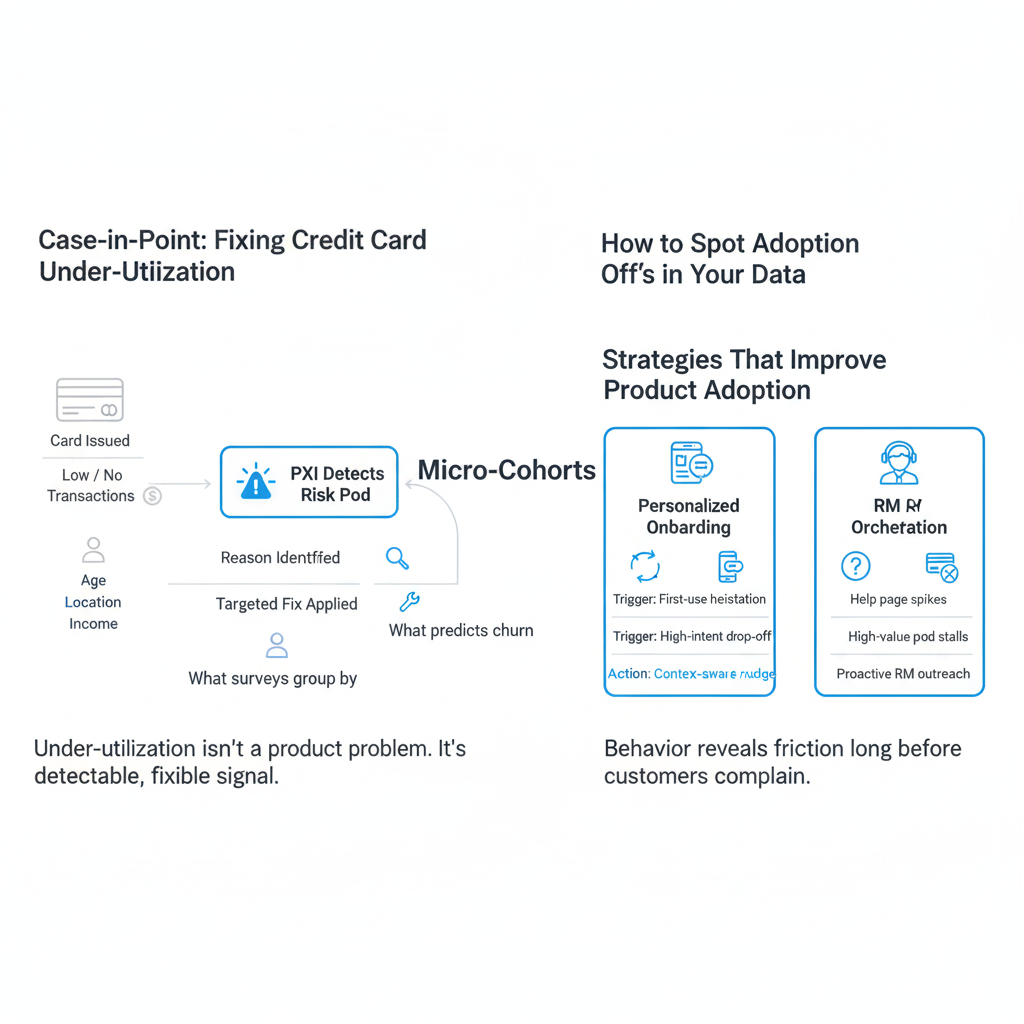
Credit cards issued and never activated are the clearest version of this problem. We covered how the drop-off happens, and what recovers it, in post-promo drop-off in new credit card usage.
How to Spot Adoption Drop-Offs in Your Data
Micro-cohort analysis (grouping users by shared behavior signals, not just demographics) - look for groups who retry the same step, switch devices, or repeatedly open help pages. These shared behaviors (not demographic labels) are the early warning signs of friction.
Session-level signals, repeated retries, device switching, and transaction errors are all visible in event logs and tell a story that surveys often miss.
Strategies That Improve Product Adoption
Once friction signals are visible, these interventions can be triggered with precision - instead of generic campaigns.
- Personalized Onboarding: Timed guidance and progressive disclosure.
- Targeted Nudges: Context-aware in-app messages and SMS for high-intent customers.
- RM Orchestration: Triggered RM outreach for high-value pods showing hesitation.
FAQ: What Banking CXOs Are Asking About Adoption
Q: Our app has many features. Is low adoption a product design problem?
While UX complexity is a factor (60% of customers abandon lengthy applications), not necessarily; often it’s a signal of unseen friction in the journey, not dissatisfaction with the product itself. We must use behavioral analytics to prioritize high-impact features and deploy targeted, in-app nudges to guide users, rather than assuming they will find the value on their own.
Q: How quickly can we expect to see ROI from improving digital adoption?
You should expect initial ROI within 6 to 12 months through operational efficiency gains (e.g., reduced call center volume) and quick wins in conversion recovery. Long-term benefits, such as the 17% CLV lift from digital advocates, compound over 18 months.
Q: What is the risk of using AI for personalization and nudging?
The biggest risk is the personalization gap: 72% of customers expect personalization, but only 3% actually use personalized tools. Our PXI approach mitigates this by using AI to analyze customer behavior and intent before sending a nudge, ensuring the message is timely, relevant, and not perceived as intrusive.
Q: How does PXI handle the "silent churn" in new accounts?
PXI detects silent churn by tracking behavioral micro-cohorts - like new customers who complete wealth onboarding but fail to invest. It then automatically triggers an ACTION (an RM alert or an automated recovery message) to re-engage that customer before the relationship decays.
Q: How can we integrate this kind of intelligence with our existing CRM?
Our PXI platform is designed with an API-first approach, enabling modular deployment that integrates seamlessly with your existing CRM, core banking, and contact center systems. We act as an intelligence layer that feeds signals and recommended actions into your current workflow, without requiring a costly system overhaul.
Next Steps: Moving from Activation Blind Spots to Predictive Growth
Digital product adoption is the new frontline in the battle for banking revenue. Banks that treat activation as a revenue process rather than a technology checklist are the ones pulling ahead.
The future belongs to the banks that turn every behavioral signal into a revenue opportunity.
Book your Strategy Session with NUMR. Discover how our predictive experience intelligence system can implement this framework to turn your digital adoption gaps into measurable revenue growth.


